
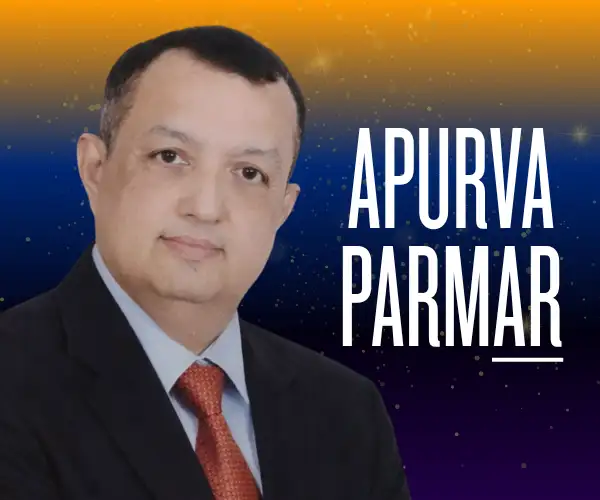
31 Years, Seven Industries, and a Career Built on One Promise: Bring Everyone Home Safe
How Apurva Parmar turned a single safety credential into three decades of leadership across pharmaceuticals, rail, ports, and energy
In 1994, a young mechanical engineer named Apurva Parmar joined Alembic Ltd. in Vadodara as an Assistant Engineer. There was no grand plan for a career in safety leadership; there was simply a job, a plant, and a quiet attentiveness to how things could go wrong before they did. Within a few years, he had already won the company's High-Performance Award, the first of many signals that he saw something in industrial operations that others walked past.
That instinct would go on to define a 31-year career spanning pharmaceuticals, heavy engineering, rail, ports, construction, and oil & gas, an unusually wide arc for any professional, and a near-impossible one to sustain without genuine mastery at its core. Parmar built that mastery deliberately: a foundation in Mechanical Engineering, layered with NEBOSH, IOSH, ISO Lead Auditor credentials, and specialised training from institutions as far afield as the University of Pittsburgh and the University of California, Davis. Few in his field can claim that combination of shop-floor instinct and global certification.
The real test of that foundation came in 2008, when Parmar joined Bombardier Transportation India as Head of HSE, tasked with building a safety function from the ground up at a greenfield site. There was no existing system to refine, only the discipline to construct one. Over the next several years, he delivered the site's first-ever ISO 14001 and OHSAS 18001 certifications, secured a Certificate of Merit and Certificate of Honor from DIHS, Gujarat, and was personally honoured by the Mayor of Vadodara for his contribution to workplace safety. It was the kind of recognition that rarely comes looking for someone; it comes because the work itself demanded notice.
"Safety isn’t a checklist, it’s a mindset you build into people, long before you build it into systems."
— Apurva Parmar
From there, the scale only grew. At Adani Ports & SEZ, Parmar helped engineer comprehensive Disaster Management Plans and an integrated HSE Dashboard across all Adani port operations, contributing to 5 million LTA-free man-hours at Adani Vizag Port, a tenure brief in duration but lasting in its influence on infrastructure that quietly powers economies. At Linde Engineering India, his remit turned international: he supported Linde's first overseas project proposals, was nominated as a global "Lead Safe" coach for the company's Behaviour-Based Safety programme, and helped his department secure three High Performance Awards while crossing the 7-million and 6.24-million safe man-hour marks at ISPRL Padur and Reliance's J3 Project in Jamnagar.
Today, as Senior Deputy General Manager – HSE Construction and Commissioning at Larsen & Toubro Energy Hydrocarbon, Parmar operates at a scale that would have been unimaginable to the young engineer at Alembic. He currently heads the Statutory Compliance Assurance Cell and the Commissioning HSE Department for L&T's Onshore EPC Projects, and is coordinating HSE oversight across some of the country's largest energy infrastructure builds, including the ₹45 billion HPCL Refinery Modernization Project in Visakhapatnam, the ₹20.79 billion AVU unit of IOCL's Barauni Refinery, and QatarEnergy's NGL-5 project, valued at ₹260 billion. Under his watch, the Cracker Furnaces Project at HMEL Bhatinda, the CDU-VDU unit, and the Full Conversion Hydrocracker Unit at HPCL Vizag together logged over 31.4 million safe man-hours without a single lost-time injury. His contributions earned him L&T's Talent Architect and Talent Maestro Awards, and a promotion to Senior Deputy General Manager in 2024.
What runs underneath all of it, the audits, the certifications, the million-hour milestones, is something Parmar has spent three decades quietly building in people rather than paperwork. He has mentored BU and site HSE coordinators, shaped succession plans for key safety roles, and made time, even amid mega-project deadlines, to speak voluntarily at universities and safety conferences, passing on a discipline he believes cannot simply be inspected into existence.
Because for Apurva Parmar, the metrics have always been a means, not the message.